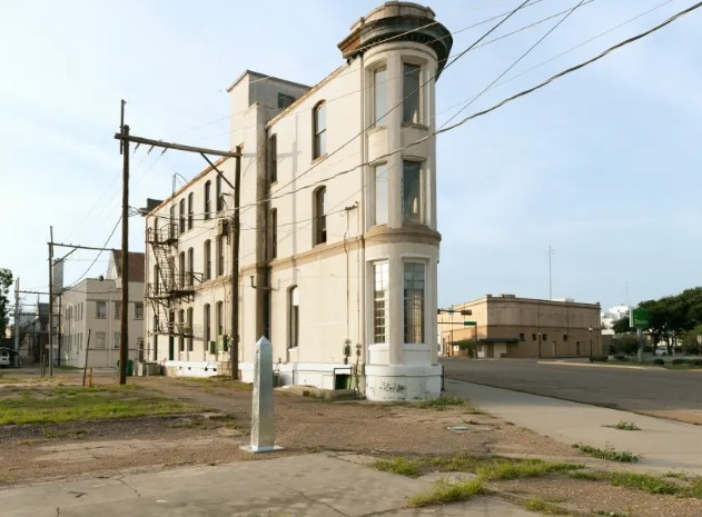

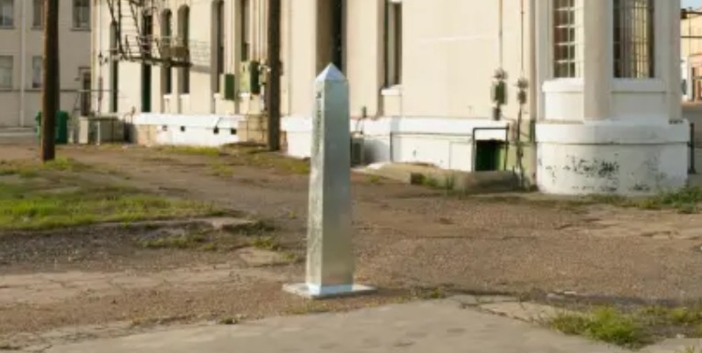
Back in 2014, locals taking part in “Haunted History Tours” of downtown Texarkana stumbled across something odd — a mysterious galvanized steel obelisk that had quietly appeared in the vacant lot between the Lofts at the Grim and the Rialto Building. At the time, no one knew exactly what it was or where it came from. A code on the structure hinted at more information, and eventually, the truth emerged: it was part of an ambitious international art project with deep historical roots.
That project, titled Delimitations, was a collaboration between University of Arizona multimedia artist David Taylor and Mexican visual artist Marcos Ramirez, also known as ERRE. Together, the duo set out to reimagine the border between the United States and Mexico — not the one we know today, but the one that existed in 1821, when Mexico had just gained its independence from Spain. Back then, the border stretched from Oregon all the way to Louisiana, encompassing much of what we now consider the American West and Southwest.
As part of their project, Taylor and Ramirez traveled over 2,400 miles from Brookings, Oregon to Port Arthur, Texas, placing 47 steel obelisks along the historic 1821 boundary. Each monument was designed to mirror the form of traditional U.S.-Mexico border markers, but with a twist — these were never meant to be permanent. They were built to invite thought, spark conversation, and eventually disappear, just like borders themselves so often shift and fade over time.

Texarkana was one of the chosen locations for this symbolic boundary line. Monument #32 was discreetly installed in a downtown lot, where it stood silently — a thought-provoking piece of historical art tucked into the cityscape.
But before the project wrapped up, Monument #32 vanished. Someone, for reasons still unknown, decided Texarkana’s obelisk needed a new home — and took it.
Now, more than a decade later, the City of Texarkana, Texas, is hoping to see its piece of international art returned. Matthew Solomon, Historic Preservation Officer for the city, has teamed up with Texarkana FYI to offer a cash reward for the obelisk’s safe return. There are no hard feelings, officials say — in fact, they’re even thankful.
“We like to think someone was just helping preserve history,” said Solomon. “But we’d love to have it back and make Monument #32 a permanent exhibit.”
The Delimitations project has only grown in significance since it was first undertaken. Using GPS coordinates, the locations of the 47 monuments can still be traced on Google Earth, where they trace a clean line through what was once Mexico. The art challenges viewers to consider the fluidity of borders — not just geographic ones, but cultural, social, and political as well.
Taylor and Ramirez designed the monuments to reflect this idea of impermanence, encouraging engagement and, in some cases, disappearance. But in Texarkana’s case, it seems the art may have engaged someone a little too directly.
Anyone with information about the missing obelisk’s whereabouts is encouraged to contact Texarkana FYI at TexarkanaFYI@gmail.com. The city hopes to recover the piece, not only to preserve history but to celebrate the broader conversation the Delimitations project continues to inspire.
“Texarkana has always sat on a border,” Solomon added. “This monument reminds us that even the lines we think are fixed can shift — and sometimes vanish altogether.”
So if you’re the mystery preservationist out there who “borrowed” a piece of boundary art: thanks for keeping it safe. But now… can we have it back?